The landscape of SEO in 2026 is changing faster than ever, with artificial intelligence, EEAT (Experience, Expertise, Authority and Trustworthiness) and predictive algorithms redefining how content ranks online. Generating online experiences by using search engines as the initial point of access (Search Engine Journal), companies can no longer follow keyword stuffing and backlinks.
The AI systems at Google, such as RankBrain and Search Generative Experience (SGE) are targeting intent, value and credibility. The future of SEO is in personalisation, the AI-controlled optimization and predictive search trends, predicting what the user needs.
According to an expert, “AI won’t replace SEO, but it will redefine how we master it”. The AI SEO tricks will determine the search giant in this new age.
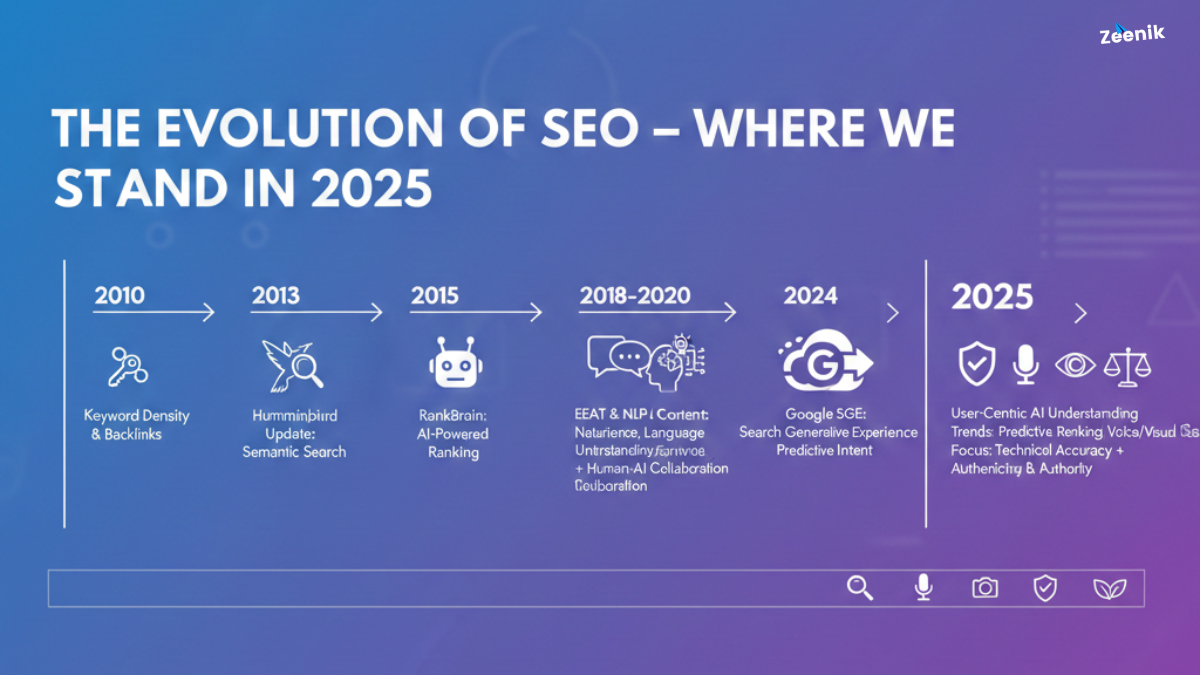
The Evolution of SEO – Where We Stand in 2025
The SEO evolution between 2010 and 2025 is an indication of the development of search engines from using keywords in the search process to being intelligent and user-oriented. Backlinks and density of keywords were the topics of SEO in 2010. Google’s Hummingbird update in 2013 changed the focus to semantic search.
RankBrain, in 2015, came with AI-powered ranking. Updates such as BERT (2018-2020) focused on natural language understanding, and it can be noted that content is more prioritized than keywords.
Between 2021 and 2023, Google reinforced its EEAT model, and content construction based on practical experience and credibility is rewarded. The AI-generated content started penetrating the market, combining robots and human imagination.
In 2024, the largest step occurred with Google SGE (Search Generative Experience), which was another step towards a new level of AI and predicting the intent to search. In 2025, however, the concept of SEO is no longer about the use of the algorithms, but rather how the AI understands what the user needs.
The current SEO trends include predictive ranking, voice search, visual search and ethical AI optimization. 2025 will require a mixture of technical accuracy and authenticity, and authority.
SEO in 2026 – What’s Changing and Why It Matters
SEO trends 2026 reflect a sturdy trend of AI-driven accuracy, content focused on human beings, and more insight into the intent of the user. Search has ceased to be about how to match words, but it is rather about telling the user what he wants before he even searches. The recent changes in Google algorithms have sophisticated AI models and predictors that take context, tone and credibility into account.
The visual and interactive layouts have attracted more visibility, as the site speed, user experience and visual engagements have turned into the new ranking base than ever. Meanwhile, content authenticity is moving to the forefront, compelling makers to demonstrate proficiency and authenticity through the authorship and first-hand knowledge.
Predictive search has now enabled Google to present results that are in tandem with current trends and behavioural information.
In brief, in 2026, SEO updates are all about equilibrium, i.e. AI optimization and real-life storytelling. The first to be adaptable will not only rank better but will create trust and authority both in the long term and online.
AI-Powered Ranking Algorithms
The predictive models used in AI SEO 2026 are becoming more important in formulating the ranking of search results. The AI of Google now uses real-time behavioral data (including click patterns, dwell time, engagement signals, etc.) to determine the meaningfulness and satisfaction of results.
This change in the position of the standing keyword relevance to the dynamical intent comprehensiveness characterizes the latest period of predictive ranking.
Contemporary algorithms are used to study the way users engage with the content across devices and rank it accordingly.
Google pages that have higher interaction, proper navigation and useful information keep climbing higher in search ranking. The machine learning systems at Google are fed on the results of feedback mechanisms that continuously improve these rankings.
This transformation has been anchored by behavioural SEO, which has rewarded authenticity, quality, and satisfaction rather than manipulation. Simply put, AI is not merely search optimization but a learning process of human cognition, prediction, and selection.
Content Authenticity & EEAT 2.0
Google has developed the approach of content authenticity SEO in EEAT 2026 to go beyond authority cues. The new model focuses on content based on experience that portrays real-life learning and personal participation. The authenticity has become conditional on the ability of creators to prove first-hand knowledge in terms of data, case studies, or personal insights.
Verifying authors is now a requirement, and Google has been verifying credentials, profiles, and reputations to make sure the information they give is trustworthy. Evidence of credibility, like the mention of external sources, citations of experts, and open sourcing, enhances the ratings of trusted producers.
Human-AI collaboration is another essential change in which AI tools can be used to design and optimise content, and human supervision can make sure that it is original and contextual. This is a combination of machine accuracy and human richness that characterizes EEAT 2.0.
Concisely, EEAT 2026 focuses on experience, identity, and integrity – rewarding creators that provide true value and are supported by knowledge, rather than those interested in exploiting the workings of algorithms.
Semantic Search & Intent Mapping
The emergence of semantic SEO has transformed the concept of optimization, in which separate keywords are no longer emphasised but the complete value and intention. Search engines interpret them by their meaning, relationships and context, and the process of matching precise phrases is omitted. It is here that the intent-based SEO is proposed – the content of what users want to know, do or buy.
The existing measures are based on themes, and there is a core pillar page which leads to sub-topics, which are interlinked with each other using internal links. This structure allows Google to know the richness and breadth of content of a particular website in addition to improving user navigation.
Search intent optimization is that which ensures that all the pages have a certain purpose, which could be either informational, navigational or transactional. Whenever businesses create inherently pleasing content, they receive greater visibility and credibility. Semantic search is not concealed by keywords but is found in the clever associations that address the desires of the users.
Visual & Voice Search Optimization
More than ever in 2026, search behavior is more visual and conversational. Visual search 2026 has become a significant frontier in SEO, and with features like Google Lens, customers are now able to search through images, objects and real-world scenes. Product images should be optimized and descriptive filenames, structured data and accurate alt text that assist Google in recognising and ranking the safety of images correctly.
Simultaneously, voice search SEO 2026 will be expanding as smart assistants take over mobile and home appliances. Users are now able to query using full questions; they do not type short phrases as a query. The conversational keywords, FAQ and the on-page clarity become critical with this ranking.
In order to remain visible, companies need to integrate voice and visual optimization – making sure that it is easy to access, clear, and responsive in all forms. Search will become multisensory, and the first responders will take both aural and observed opportunities.
Schema & Structured Data 2026
Structured data has taken the place of the foundation of how Google perceives and presents information in schema for SEO in 2026. Rich and connected schema is trusted to describe relationships between people, brands and content in search engines. Markup, Structured data SEO is more than a simple markup – it allows more intelligent visibility by providing more advanced snippets, carousels and knowledge panels.
The article schema of blogs, the FAQ schema of interactive answers, the video schema of multimedia ranking, and the author schema are some of the modern strategies to be used in order to verify expertise according to EEAT 2.0. The entity schema also assists in connecting the content to known identities that enhance trust and authority indicators.
Most of the implementations are done with JSON-LD, which is the preferred format by Google, and it can be easily integrated into the code of the website. Convincingly, schema will stop being optional in 2026 – it will be a strategic interface between AI, context, and credibility. Websites being built based on more sophisticated schema structures have an admitted advantage in search visibility nowadays.
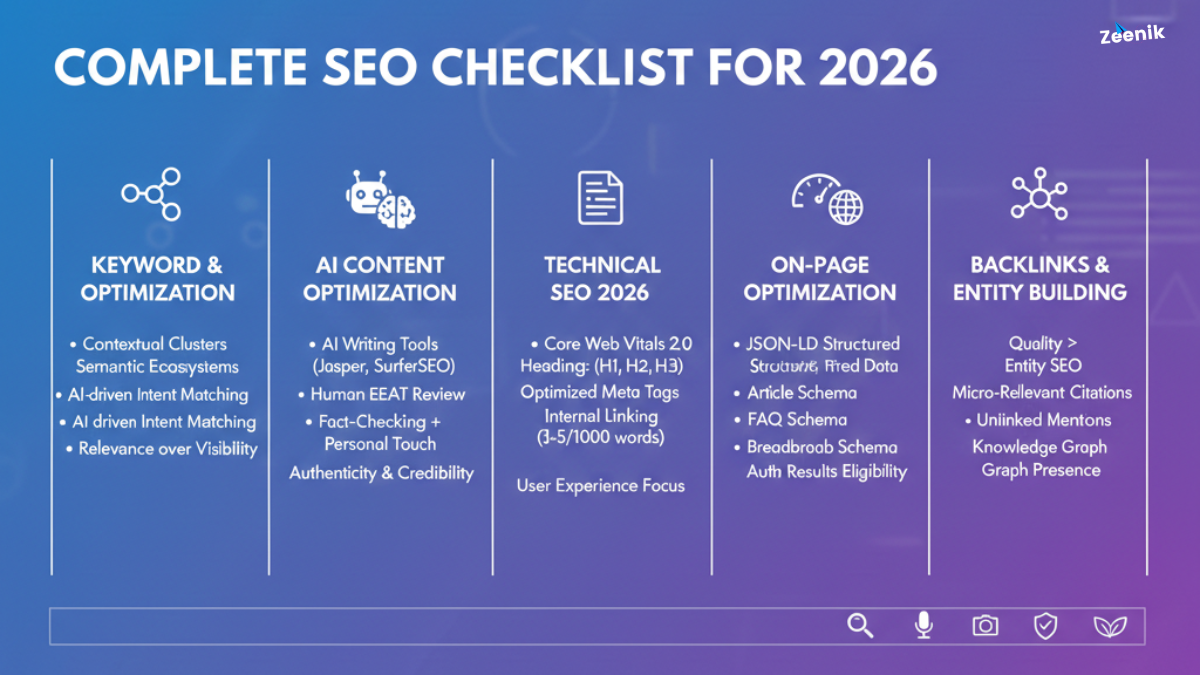
Complete SEO Checklist for 2026
The following is the handy-dandy (do) portion of your plan, a full-blown SEO checklist 2026, to help you keep changing with the times in terms of being ahead in the competitive search world. This guide will guarantee that all its important on-page SEO in 2026 factors are tuned to AI ranking systems.
Keyword & Intent Optimization
In the keyword optimization 2026, the isolated keywords are no longer emphasized but rather interrelated SEO keyword clusters that imply the actual search intent. Businesses no longer focus on specific words; rather, they are establishing more topic ecosystems with every page having a larger theme. It begins with the identification of the main topics and continues with expansion into semantic clusters with the help of AI-based tools to reveal intent-based variations.
It is necessary to match search intent, informational, commercial, or transactional; any keyword should correspond to user purposes. The keyword tools based on AI extrapolate the engagement data and predictive patterns and propose phrases that the user is likely to search next.
It is not all about visibility but relevance. Intent and semantic relationship-based content structure assists Google to appreciate expertise, as well as enhancing the click-through and dwell time. To put it briefly, keyword optimization 2026 will be contextually thoughtful, anticipatory, and the development of relatable and interconnected content experiences.
AI Content Optimization
Jasper and SurferSEO are advanced AI SEO tools that are changing the process of how creators plan and optimize digital content in AI content SEO. Such platforms apply the insights of data in order to study competition, place keywords appropriately and ensure that the tone and readability are appropriate. They contribute to satisfying every page to the purpose of search and enhance structure and topical coverage.
Nevertheless, trust or authority will not be attained through automation. As a human, EEAT review, experience, expertise and authenticity can only be justified. Authors ought to check the facts generated by AI, include personal comments, reference credible sources and use the brand voice. This partnership between human decision and AI accuracy generates content that is high-ranking but appears to be real and credible.
The future of AI content SEO resides in moderation: the use of AI will increase creativity and speed, although all works should be qualified as true knowledge and credibility.
Technical SEO in 2026
Technical SEO in 2026 has performance, accessibility, and automation in its success criteria. The latest version of Google Core Web Vitals 2.0 extends the metrics of user experience to include factors like visual stability, interactivity and page responsiveness on all devices. Sites that provide frustration-free, fast and smooth experiences receive a high ranking.
IndexNow has also taken a significant turn of events as it enables instant submission of URLs to the search engines to ensure rapid indexing. Mobile-first optimization is also a prerequisite since the majority of the traffic is still through smartphones. The pages should not take time to load, they should adapt to the screens and should execute the functions fully on the small screens.
Crawlability is equally important, and it consists of making sure that your site is easily accessed and interpreted by search bots and rendered. Good sitemaps, well-organised data and faultless indexing indicators are key. In a word, technical SEO in 2026 is a combination of speed, structure and intelligence that will assist websites to work perfectly in an AI-driven search space.
On-Page Optimization
In on-page SEO in 2026, no one is successful by design except for structure and clarity. The search engines have now given importance to well-organised and easily navigating content. The beginning of a good heading SEO is to have only one H1 heading that is a clear representation of the subject, then the rest H2 and H3 headings are to follow in a logical order and hierarchy. This contributes to the fact that Google and readers understand the context of each section within a short period.
The meta tags are still vital in terms of visibility. Titles and descriptions are well-written, have a higher chance of click-through rates, and indicate that they are relevant to the search intent. Optimized metadata must be incorporated on each page, and it must reflect the target keyword naturally.
The internal linking is also heavier than ever. It should have 3-5 internal links on 1,000 words to interlink the related pages and share the link authority. On-page optimization, when properly performed, can deliver a better user experience and searchability to your site. This also makes the site easier to discover in the changing environment of on-page optimization 2026.
Schema Setup
The use of JSON-LD schema has been a necessity in the schema setup of structured data in 2026 to achieve visibility and trust. JSON-LD (JavaScript Object Notation Linked Data) assists search engines in the clear interpretation of pieces of the pages to enhance the appearance of the content in SERP. Avoid using the rich results, carousels, and featured snippets: make sure that your pages are eligible.
Begin by including Article schema to emphasise on headlines, dates of publication and authors. Support the FAQ schema to show interacting question-answer fields on the results of the search. With breadcrumb schema, it becomes easier to navigate through the site by indicating to the user the position of where they are in the site. Finally, add the Author schema to certify expertise and connect content to actual, known creators as part of EEAT 2.0.
You must add all your schemas in the header or body of your page in the type of script which is application/ld+json. A properly configured modern schema improves comprehension, trustworthiness and classification of possibilities in the emerging structured information ecosystem at Google.
Backlinks & Entity Building
The quality and context hold much more importance in the case of backlink 2026 than the quantity. Now Google performs the role of backlinking analysis based on the entity SEO concept that puts emphasis on the relationship of your brand, content and authors with other websites. Citations by micro-relevant and high-authority domains are credibility enhancers, as well as the unlinked mentions of the brand, which are indicative of recognition and trustworthiness.
Creation of entities — recognizable profiles of individuals, companies, or themes assists Google in mapping connections in its Knowledge Graph. This enables your brand to be shown on the more rich search results, panels, and suggested queries. Entity signalling is enhanced through referring to verified authors, relying on schema, and having similar information on profiles.
The current method of link building is not about quantity seeking anymore; it is about fostering digital authority. By integrating verifiable backlinks, constant brand presence, and compatibility of entities, long-term visibility and stability on search ranking of backlinks in 2026 and beyond will be achieved.
Analytics & Tracking
In 2026, the process of SEO tracking is based on the smarter interpretation of data and automation. Having GA4 SEO as its core allows marketers to gain more knowledge about the behavior of users, their engagement processes, and predictive performance indicators. Having event-based tracking, GA4 provides the ability to accurately measure actions of users such as clicks, scrolls and conversions across devices to give a full picture of visitor engagement.
In addition to Google Analytics, AI-driven dashboards are responsible for integrating several information sources to draw real-time SEO insights. They are used to identify the trends, anomalies, and ranking fluctuations automatically and assist teams in making decisions that are more readily based on data.
There is also a new development in user engagement tracking, with the focus on meaningful metrics, including the quality of the session, time on page, and the depth of interaction. These tools combined provide SEO analysis with a transition to actionable intelligence. In brief, AI dashboard and advanced analytics in 2026 will ensure optimization is proactive, predictive and exactly as the user would want it to be.
SEO Tools You’ll Need in 2026
The future of SEO tools in 2026 is based on the integration of AI, automation, and smarter analytics. Such platforms make it easy to research keywords, conduct technical audits, optimise content and provide predictive insights to use in planning their strategies. The following are the key AI SEO software selections in the lead.
- SurferSEO – SurferSEO is an AI-driven optimizer of the on-page elements, structure and keyword density based on the SERP.
- MarketMuse -Manages content strategy through mapping topic clusters and detecting content gaps.
- Jasper – AI writing assistant capable of generating human-like content with the use of SEO and the consideration of EEAT rules.
- Screaming Frog – This is a powerful Web crawler that identifies technical problems, redirects, and any broken links.
- Ahrefs – Full domain information, backlinks, and keyword analysis tool.
- Semrush – Everything in one competitive research, key tracking, and performance analysis.
- Clearscope – The tool involves semantic optimization and understandability enhanced with the analysis of artificial intelligence.
- Google Search Console- This is crucial in tracking site indexing, impressions, and performance in terms of the Core Web Vitals.
The combination of these tools simplifies the contemporary business of optimization, creating a combination of automation and accuracy.It maintains a business on the leading edge of the changing AI-driven optimization environment.
Predictions – The Future of SEO Beyond 2026
The personalization, automation and increased AI-human collaboration will shape the future of SEO in the five-year perspective. The search engine is shifting towards the personalized SERP, whereby a search result of a user is customized depending on preferences, behavior and context. Optimization by keywords is not enough, so in terms of audiences, including knowledge of emotions they are going to stimulate, the tone of content and the need is crucial.
The AI content SEO will also enter a new stage known as AI parity, when machine-generated and human-generated content can no longer be differentiated by quality and purpose. Its authorship will no longer be the most important distinction factor, but the level of authenticity, insightfulness, and reliability.
Real-time ranking changes will also be a reality, and algorithms will dynamically change results based on engagement and intent signals. SEO will be an evolving process as opposed to a campaign.
Voice, visual, and predictive search will become one intelligent ecosystem where the content has to be available in more than one form at the same time.
To remain on top, brands have to be innovative, invest in AI literacy and value creation in real life. The following generation is the one that grows quicker than the algorithms, begins changing now and spearheads the revolution that will define the face of SEO in the future.
FAQs – SEO in 2026
1. Is SEO still relevant in 2026?
Yes, SEO remains essential. Although AI consists of increased automation, strategy, innovation, and trust indicators continue to depend on human knowledge. Companies that will evolve with the new ranking systems and orient on the intent of the user will keep expanding on the internet.
2. How does AI affect SEO?
AI personalisation refines the search results and is more intent-aware. It affects ranking based on prediction algorithms, engagement metrics, and quality control of content. AI assists in the automation of auditing, search of keywords, and content optimization, but requires human examination to meet the requirements of EEAT.
3. What are the main ranking factors in 2026?
The largest ones are content authenticity, user experience, EEAT 2.0, Core Web Vitals, and entity-based authority. Ranking can also be predicted by predictive indicators such as dwell time and interaction depth.
4. What is predictive SEO?
Predictive SEO is an AI-based tool that predicts tendencies in search and user behavior ahead of query execution. It assists brands in developing the content expected in the future, enhancing visibility and conversions.
5. How do I optimize for AI search engines?
This is intent-oriented high-value content with schema markup, author validation and internal links. AI tools may be used in research, though human editing is necessary to give it credibility and originality.
6. What will the future of SEO look like after 2026?
Personalized SERPs, dynamism in ranking and voice, visual and AI-driven search are expected. The use of SEO will be more responsive and rewarding naturalness, proficiency and significant user experiences.
Conclusion
It is the future of search, and your SEO strategy 2026 will need to be adapted to it. The new era of success requires AI accuracy combined with human ingenuity and reliability. Those brands that will be the most visible and convert the most will be those that adopt hybrid optimization, where AI provides insights and human authenticity. The SEO rules are evolving rapidly from EEAT 2.0 to predictive ranking. It is time to start optimizing to make sure that you are ahead of those changes and are ranked in the search results tomorrow.
Want to rank higher in 2026? Get in touch with our professionals or follow us to receive the newest AI-dynamics of SEO.